Ernest Estrada Sanchez – Young Man and Navy
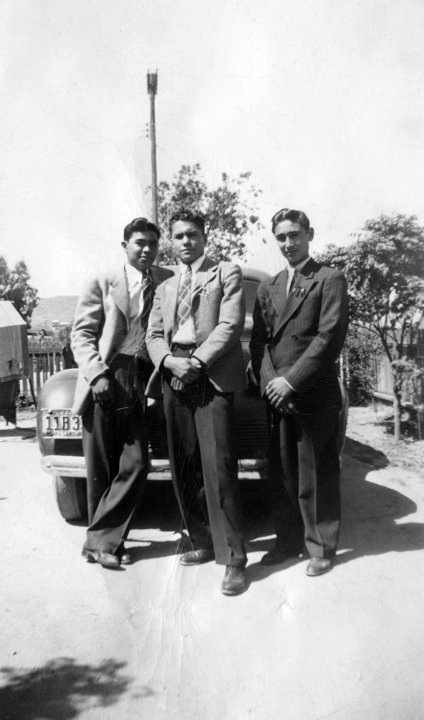
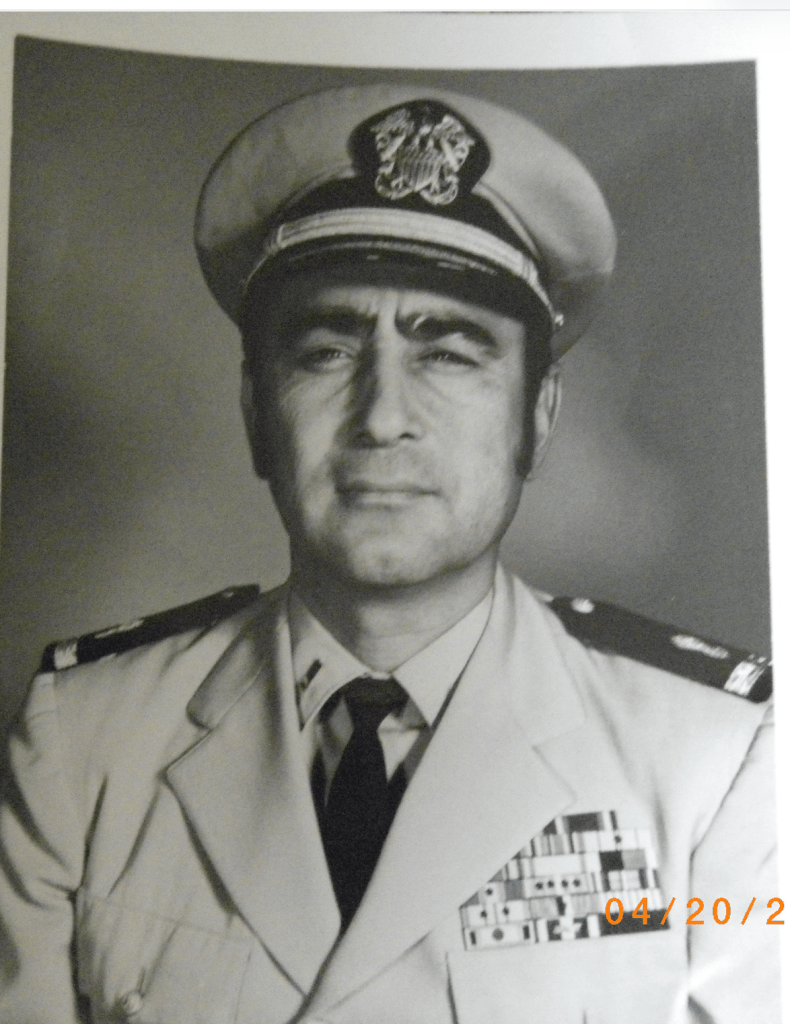
As the youngest son of Ernest Sanchez, I only have one photo from his youth in Tucson, Barrio Libre. I knew he grew up fast and quit school. Left. Click to Enlarge. The undated picture shows my father sporting a slick suit, Pachuco style. I’m guessing the year is 1943 and my Dad was probably 16 years old. Right. Click to Enlarge. My father as he retired as the highest ranking officer in the US Navy in 1971, as non-commissioned officer (CWO4-no college).
I got the idea as I grew up, that my Grandfather Joaquín wasn’t happy with the path my father was taking as a teenager. My dad never talked to me about this part of his life. My mom told me a little. After he quit school in the 9th grade, the only thing I remember him telling me “he chose the school of hard knocks” (Look it up). He carried on his hand an old school tattoo in the form of a cross. My mom said it was a reminder from an unwelcome experience during his youth.
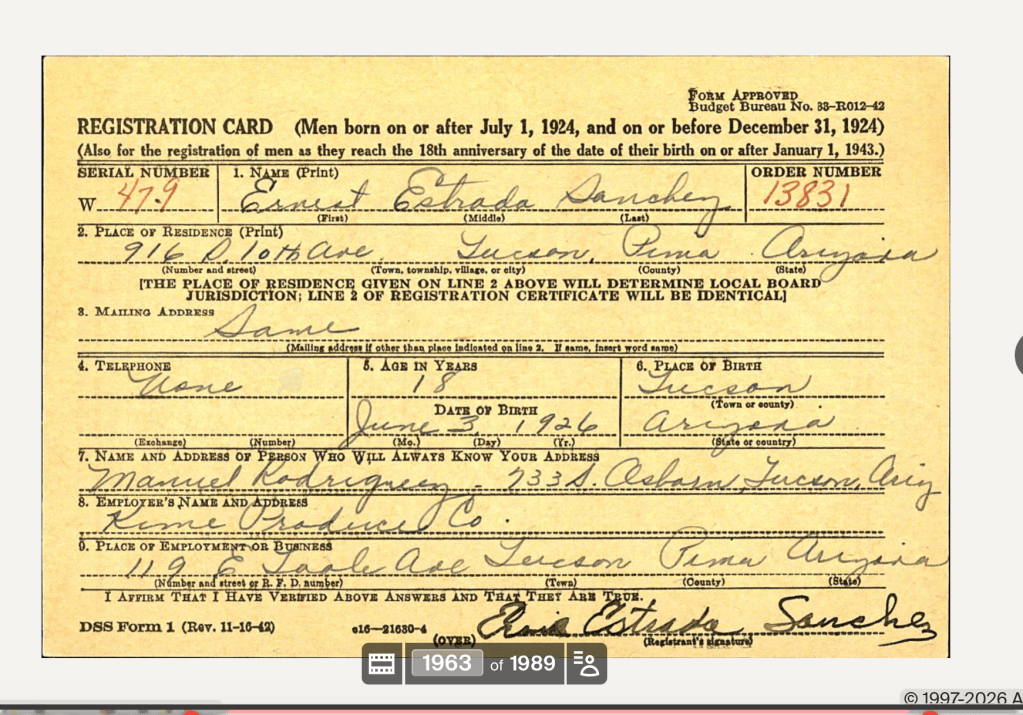
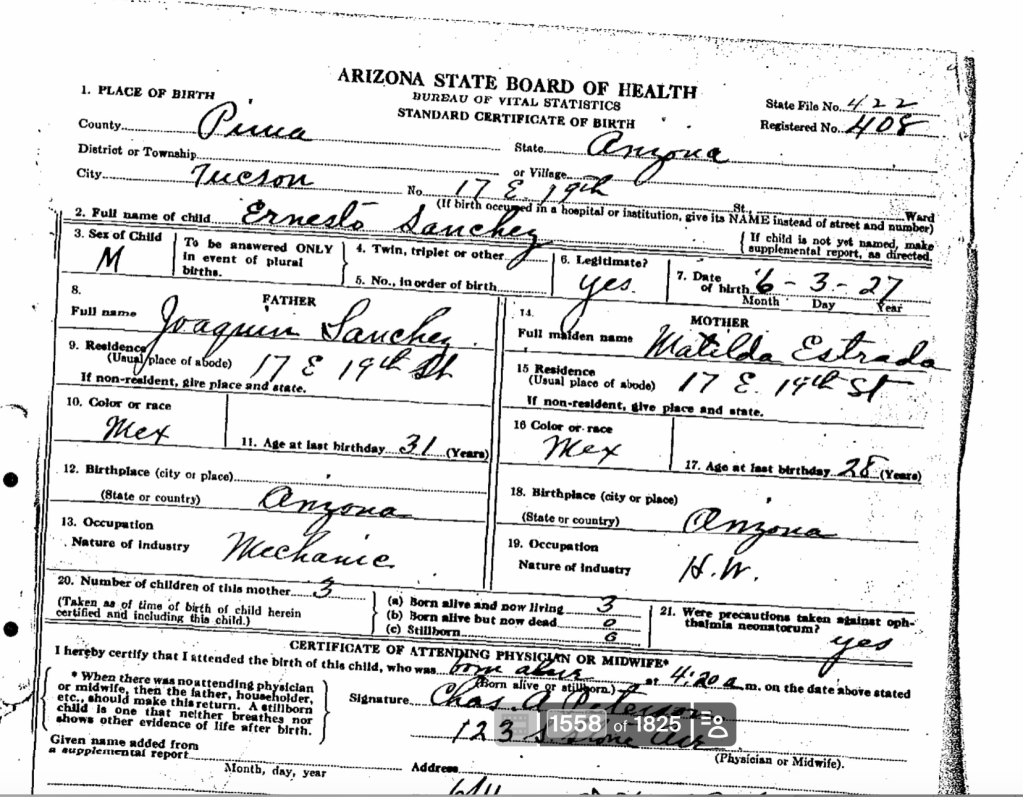
About the time he quit school he married a young girl named Dora Guerrero in October of 1943. They had two children in 1944 and 1946, Olga and Ernest Manuel Sanchez. On June 3rd, 1944, he joined the Navy. Below left. Click to enlarge. This is his military registration filled out on his birthday 1944. He still lists his residence as his parent’s house although married. And a well known family secret: he entered the military before 18 years old (Birth Certificate- below Right).
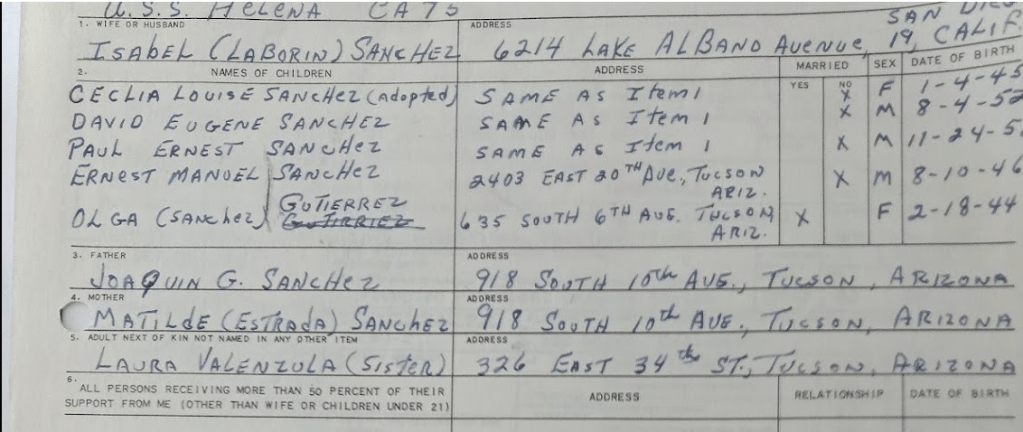
He was stationed on many ships during his time in the Navy. Below. The record below is a list of his family contacts from around 1960 while on the USS Helena. Dora Sanchez and my Dad had been divorced for many years. Listed first, my mother Isabel Sanchez, my sister Cecilia, my brother Dave and the two year old (Me 1958). Under my family, he lists his children with Dora. Ernest Manual Sanchez, my half-brother, was probably 14 years old. And my half-sister Olga had apparently already met and married her husband Marty Gutierrez. Under my Grandparents he lists his step-sister Laura (Machado) Valenzuela.
Navy Career
My Dad spent most of his 25 year career on several ships and in the mid to late sixties, at least one aircraft carrier. Below. Click to enlarge. The first was the light cruiser USS Tucson (CL-98) commissioned on February 3, 1945 (Tucson coincidence). The USS Tucson (CL-98) was part of the anti-aircraft screening force for the Fast Carrier Task Force 38. This task force conducted the final carrier air strikes against the Japanese home islands until it’s surrender in September 1945. They later occupied Japan, with my Dad spending some time as a military police officer.
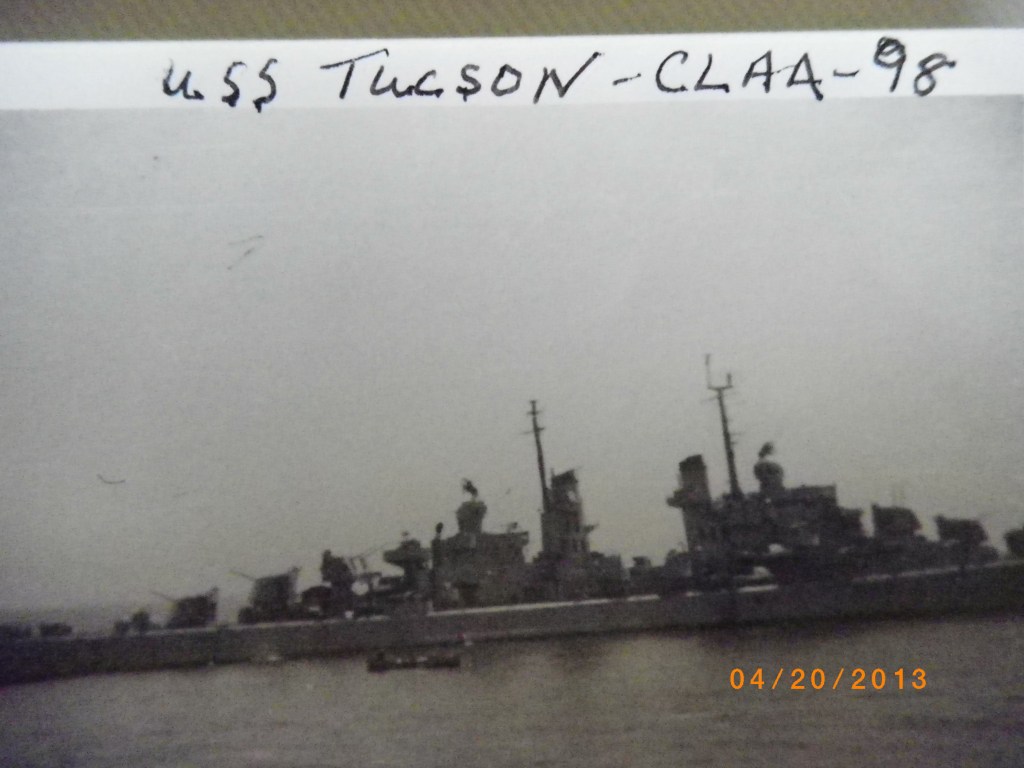
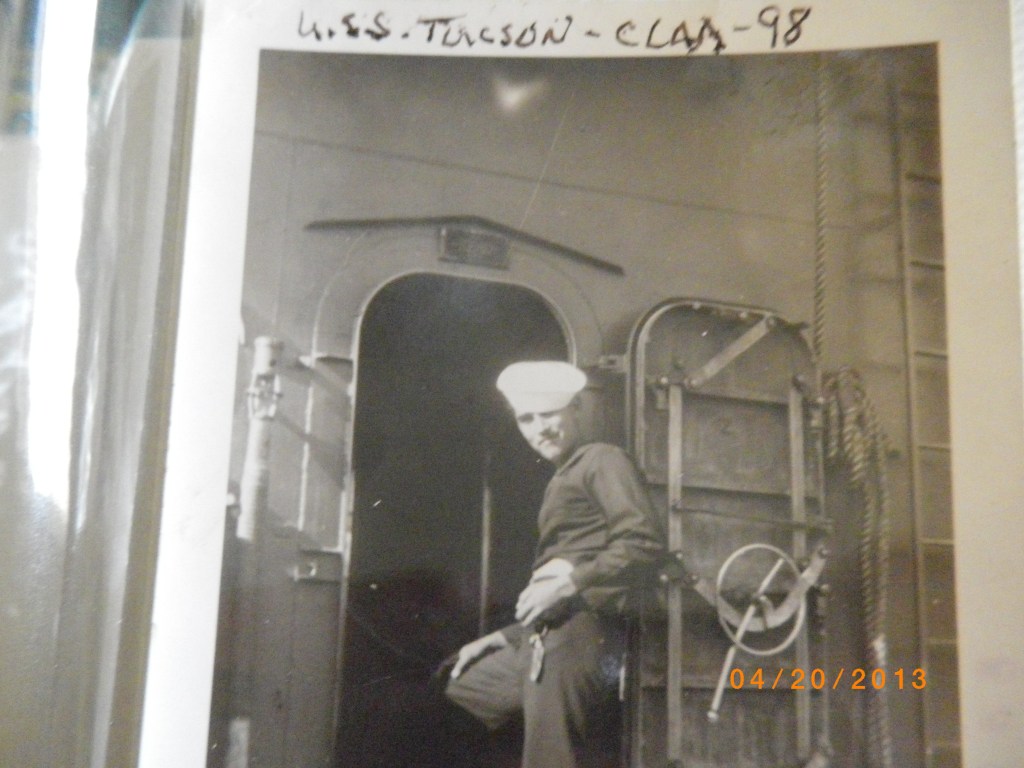
The USS Tucson (CL-98) was a heavily armed, fast warship designed for anti-aircraft defense, shore bombardment, and surface combat. Their mission: to protect the destroyers and aircraft carriers Below. The photograph shows the six large 5-inch twin turrets designed for both surface action and anti-aircraft defense. My dad was a gunner’s mate. Gunner’s mates manage the rapid loading mechanism on the 5 inch guns or operate the 40mm and 20mm anti-aircraft guns. They did a lot of maintenance to maintain proper operation of all guns. Removing corrosion and inspecting and repairing hydraulic and pneumatic systems was part of the job.
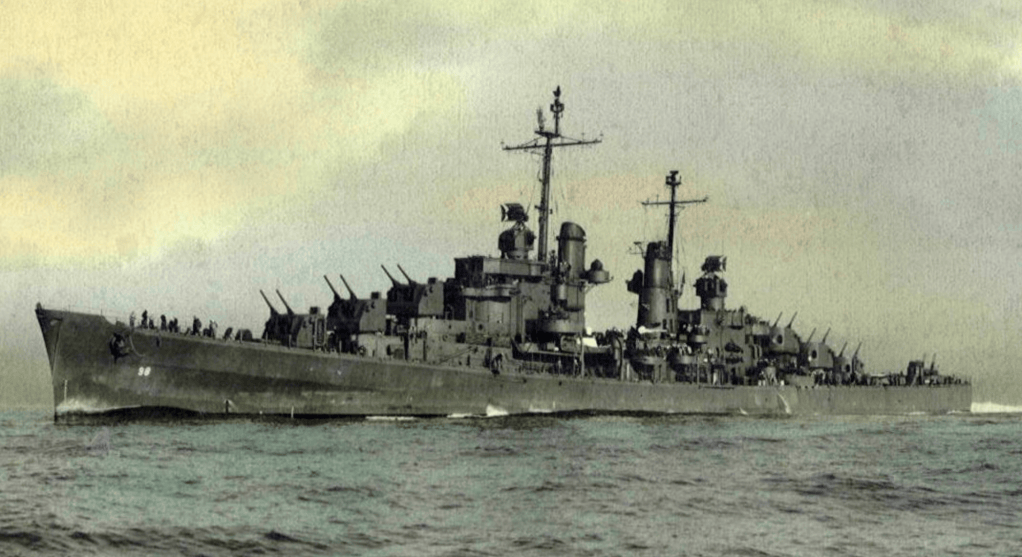
Above. The USS Tucons. Below. USS Perkins (DD/DDR-877). By 1947 my Dad began a long tour on tour on the USS Perkins , a Gearing-class destroyer in the United States Navy. He told of an experience involving observation of atomic tests in the Pacific.
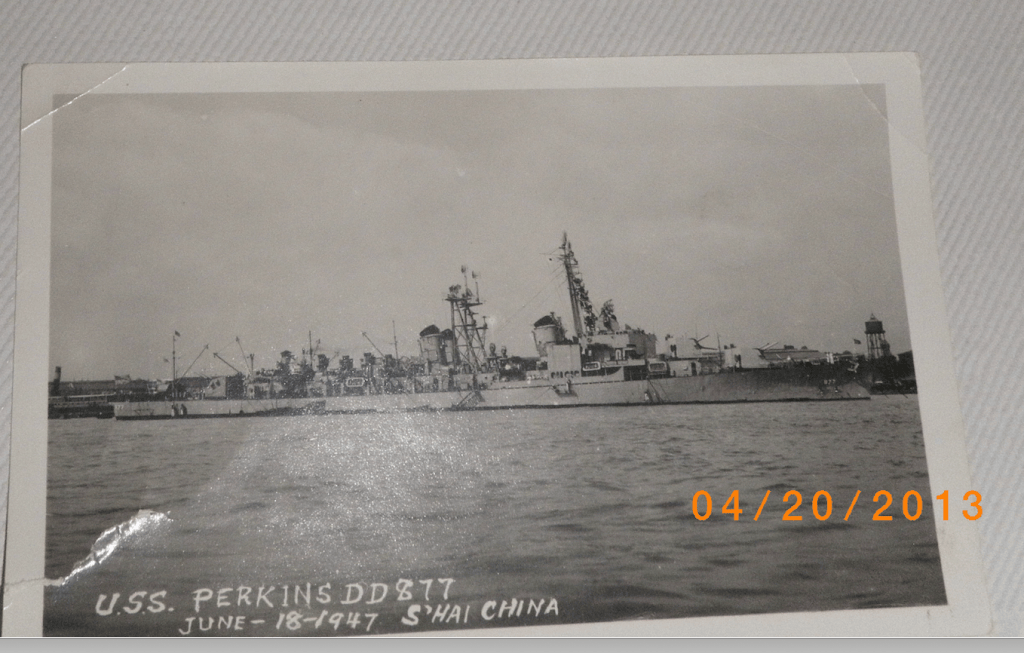
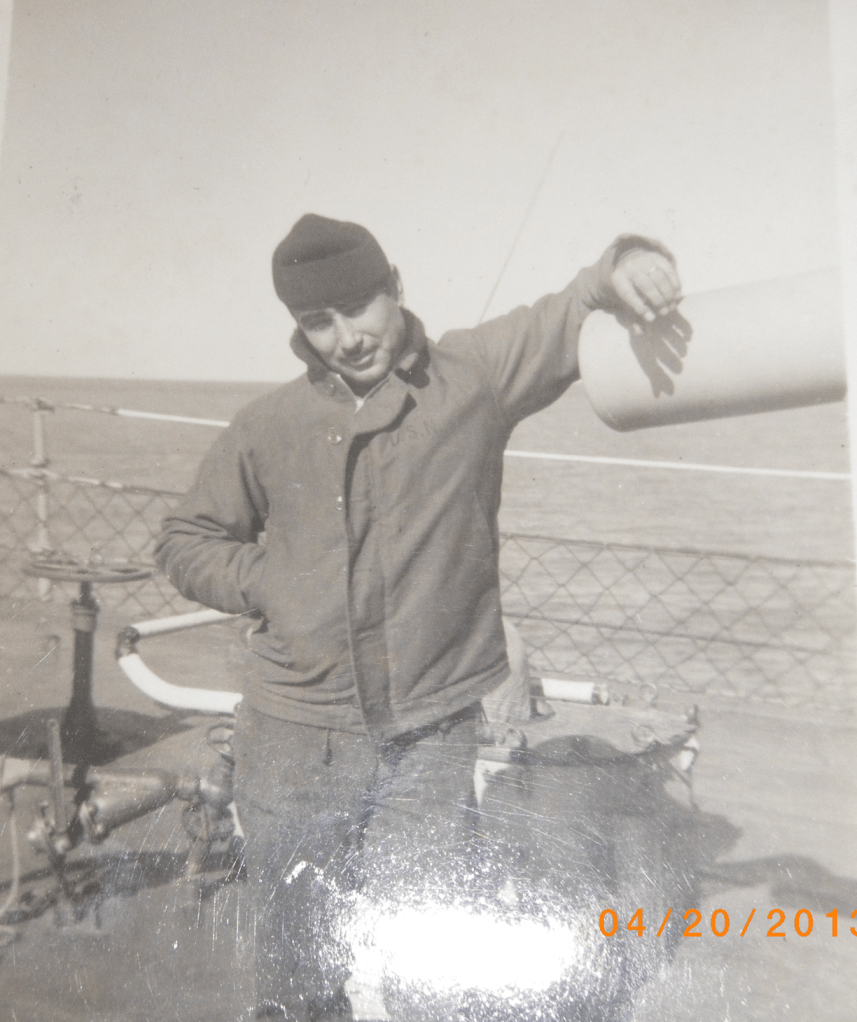
Below. I couldn’t find photos from the 1948 nuclear tests involving the USS Perkins. My Dad told me the story that while the officers remained shielded inside the ship, the crewman were told to cover their eyes above deck. At the time of the detonation, he saw an X-ray of his hand covering eyes. He told me the ship was located about half mile away. Official accounts say crewman were given viewing shields and were not that close.
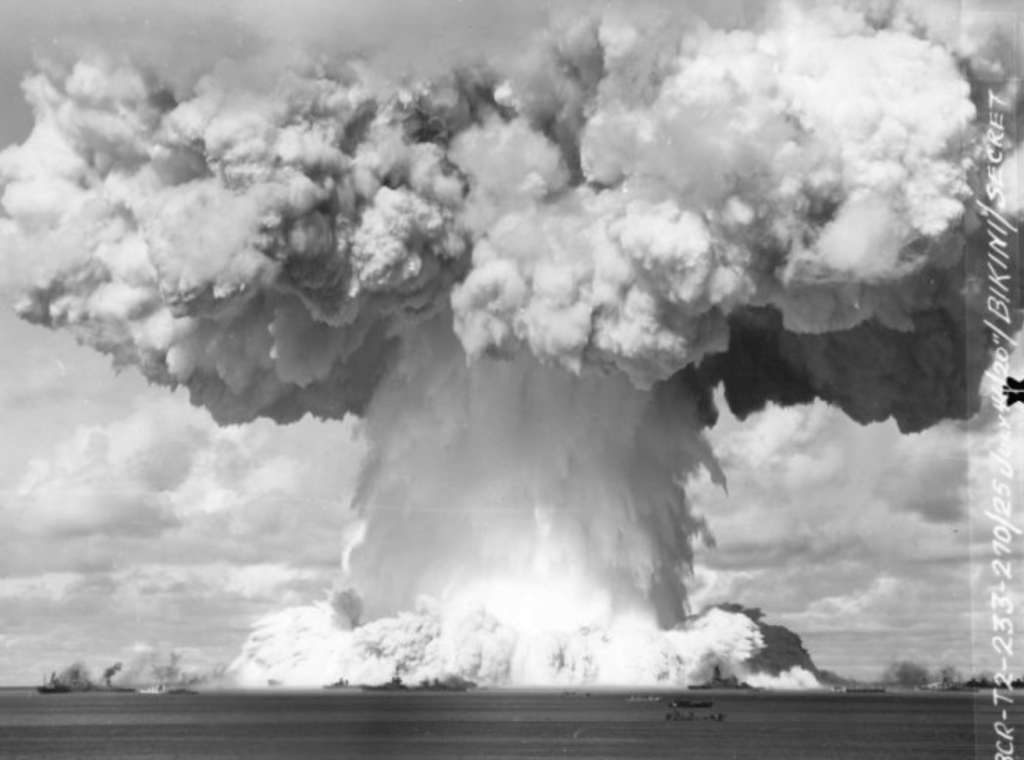
Above. As the cold war with the Soviet Union began, there mission was to support the atomic tests in order to improve the weapon design.. The tests led to changes in the design using an oralloy (enriched uranium)-plutonium composite core, creating more force. Here our lives over lap. In the 1990’s, as a geologíst, I worked on an underground facility to safeguard the plutonium contamination left over from bomb’s fabrication. Another overlap will come.
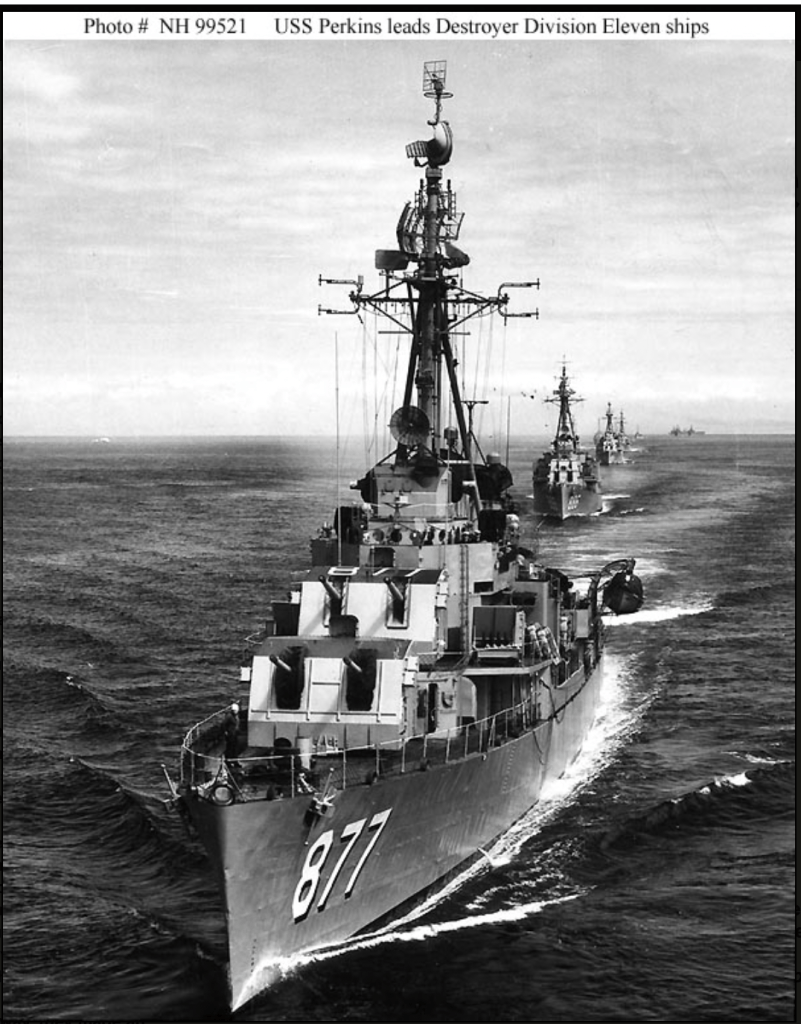
Above. In the early 1950’s the USS Perkins became involved in the Korean War involving bombardment of the Korean Peninsula and safeguarding the fleet. But first off the China coast in 1949, the Perkins rescued foreign residents of Tsingtao to Hong Komg as Communist forces took over the former city. On 2 February 1951 the Perkins got underway for the embattled coast of Korea and spent months providing gunfire support and shore bombardment missions. In 1951, one of her crew was killed and 17 were wounded from Communist shore batteries. The Perkins was in the battle until my father was reassigned in 1953.
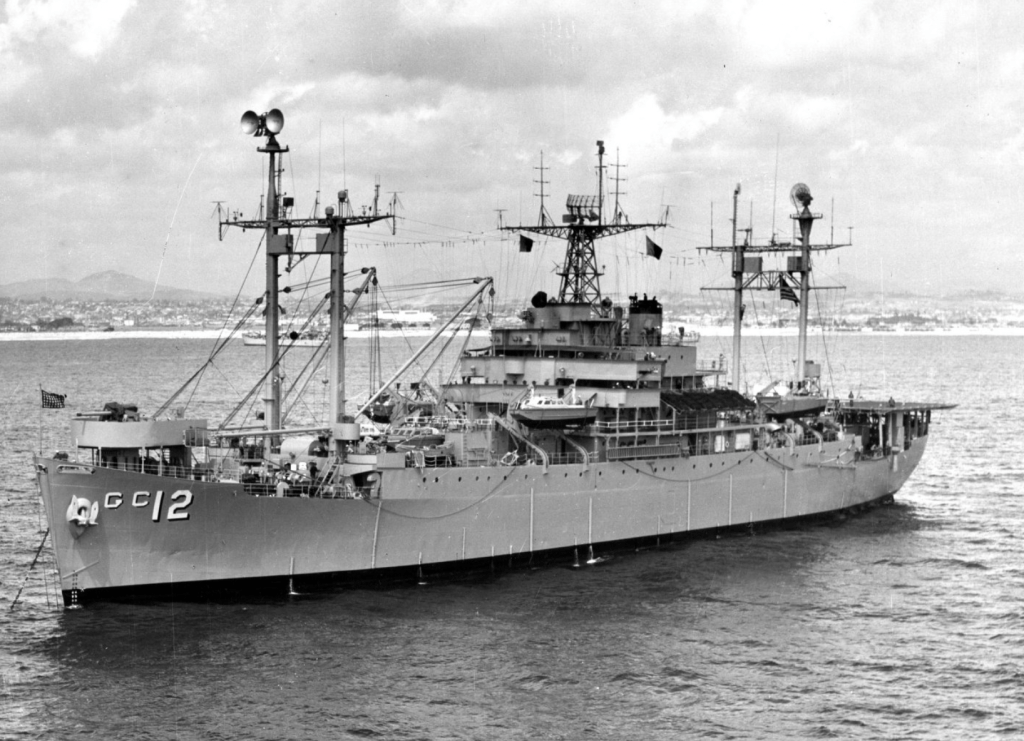
Following the conclusion of the Korean War in 1953, my Dad was transferred to the amphibious force command ship USS Estes (AGC 12) .The USS Estes conducted vital cold war operations and humanitarian missions, but more importantly led several significant Pacific thermonuclear weapons tests.
In 1954, the USS Estes sailed to the Marshall Islands at Enewetak Atoll as a primary control and observation ship for highly secretive Operation Castle nuclear weapons test series. Indeed, my Father’s path led him to a nuclear command ship that unexpectedly shaped his career in the 1960’s. His tenure was about 1954 through 1958.
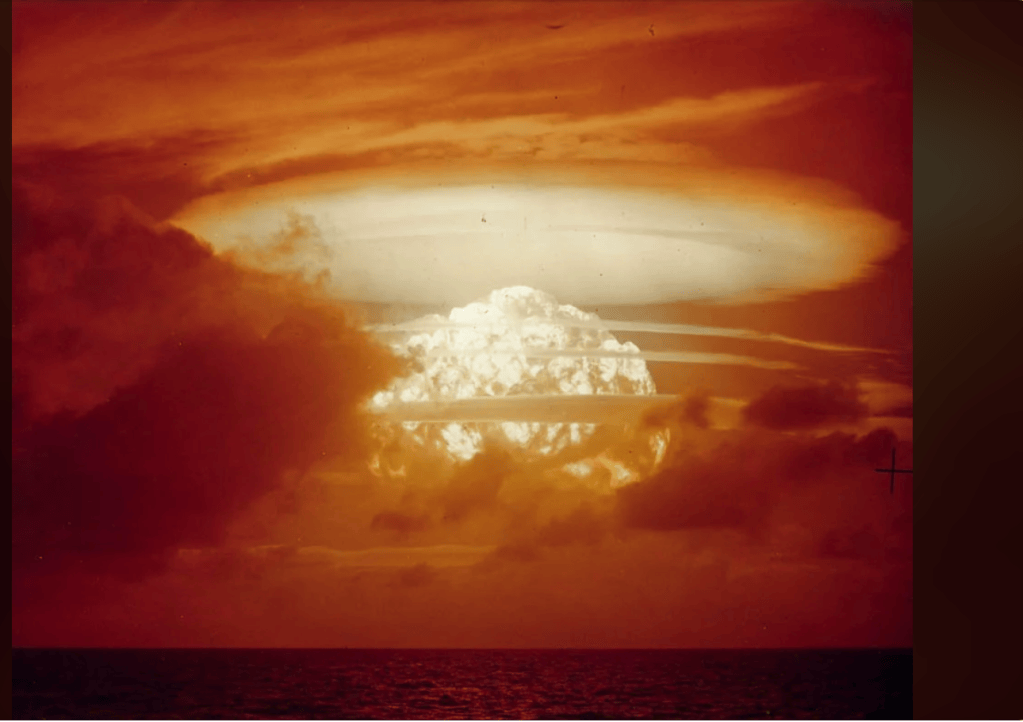
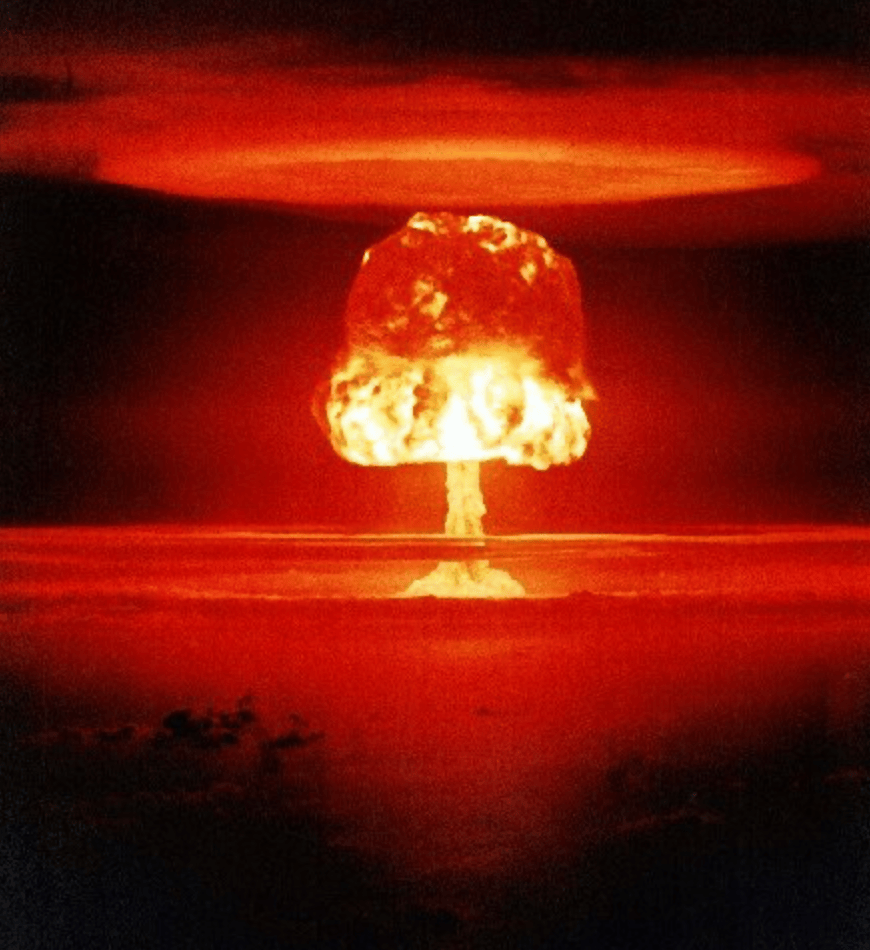
The US National Laboraries and the USS Estes crew conducted scientific research, including measurements of seismic abd acoustic effects, and electromagmetic pulse at detonation. The 18 – 22 megatons bombs they tested produced fireballs nearly 6 miles wide.
Below are some personal photos, most probably from the 1940’s and 1950’s.
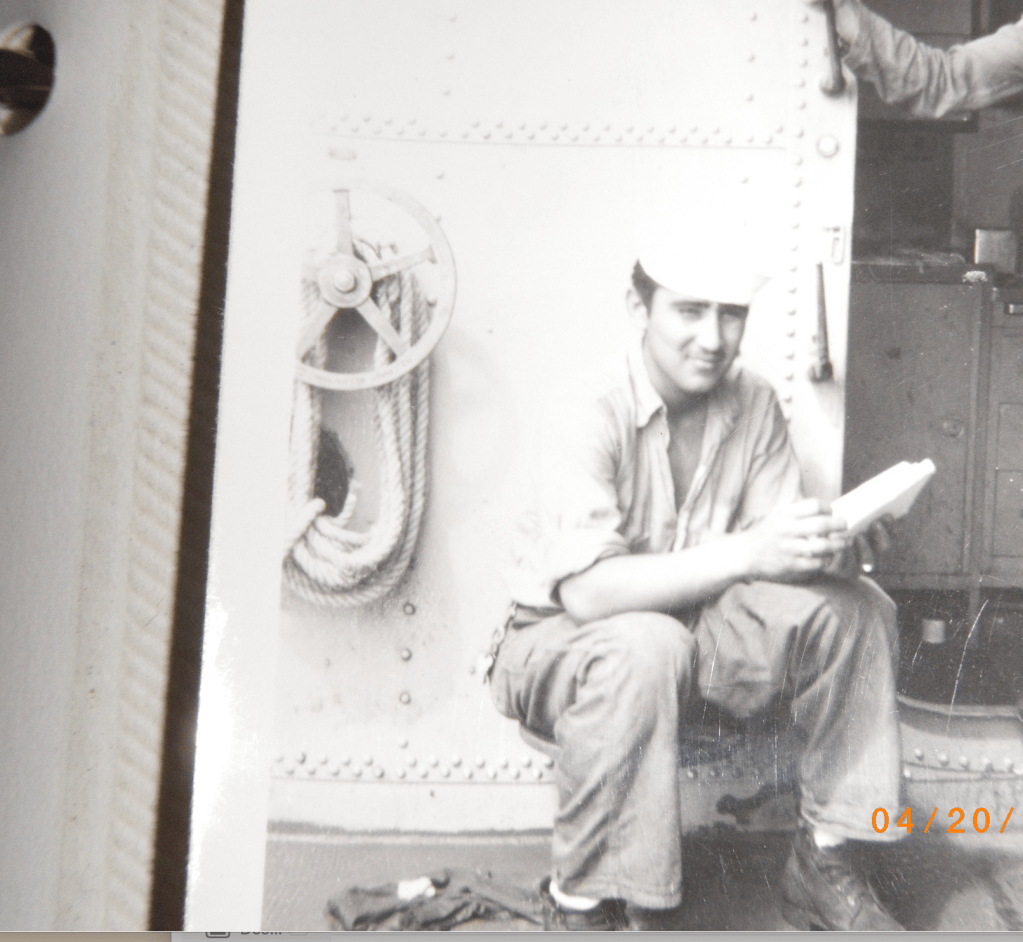
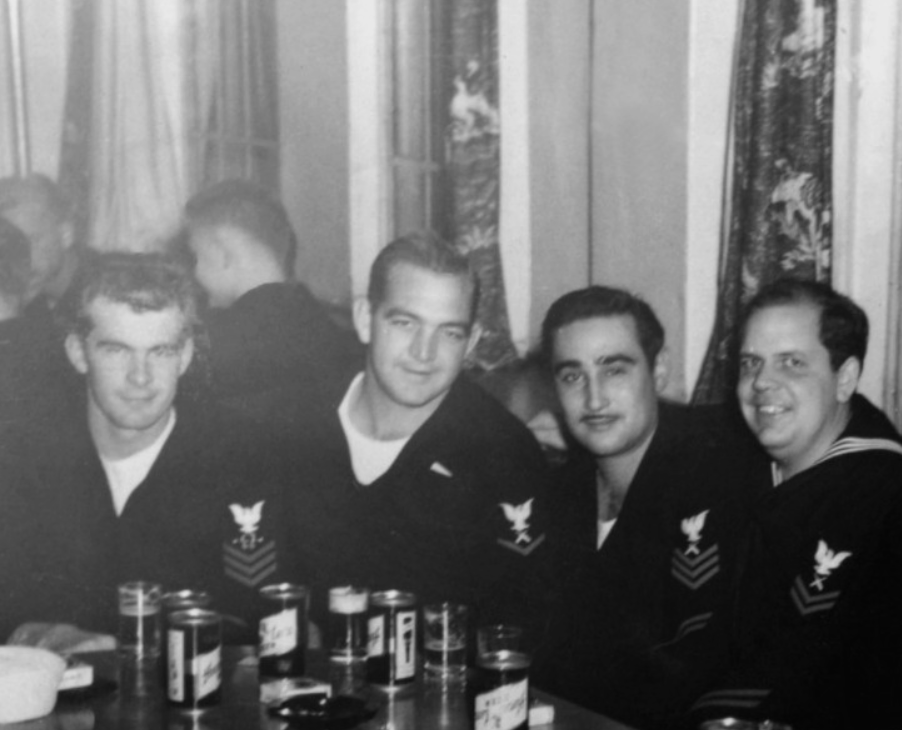
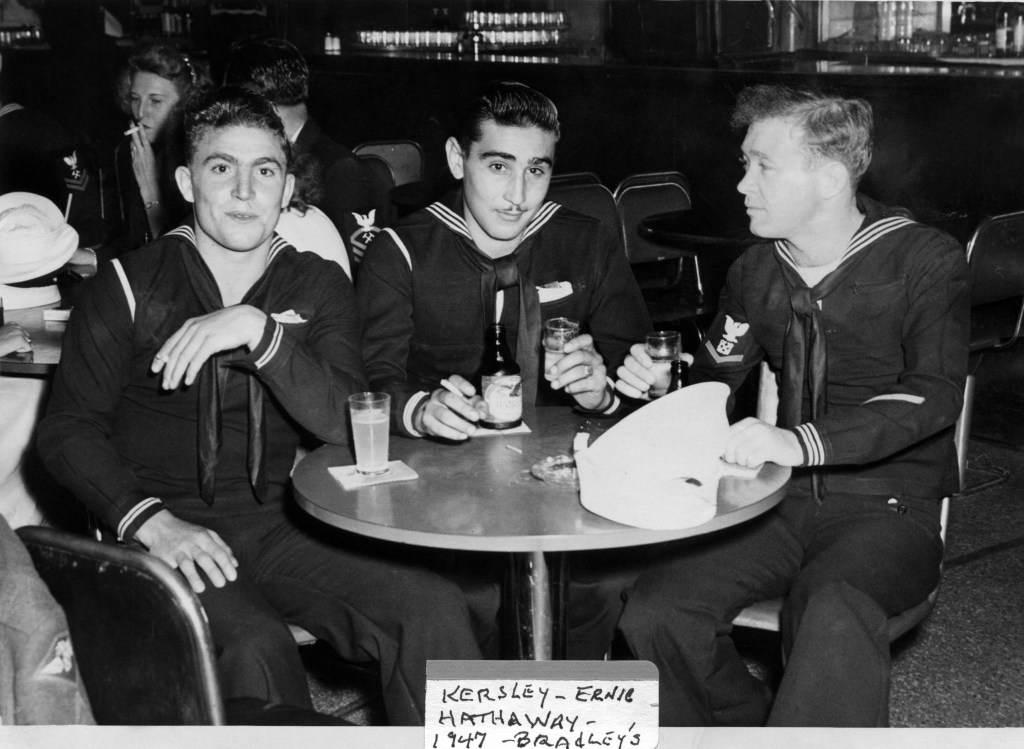
I’m guessing most these pictures were from his long-deployment on the USS Perkins. Many of his shipmates on the USS Perkins became his life long friends.
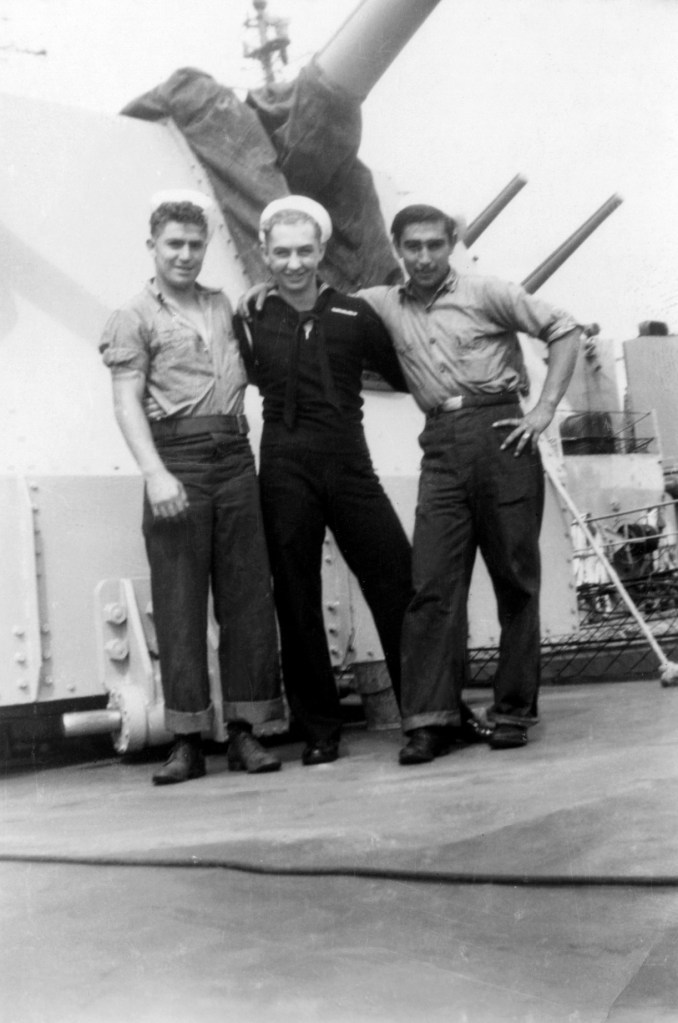
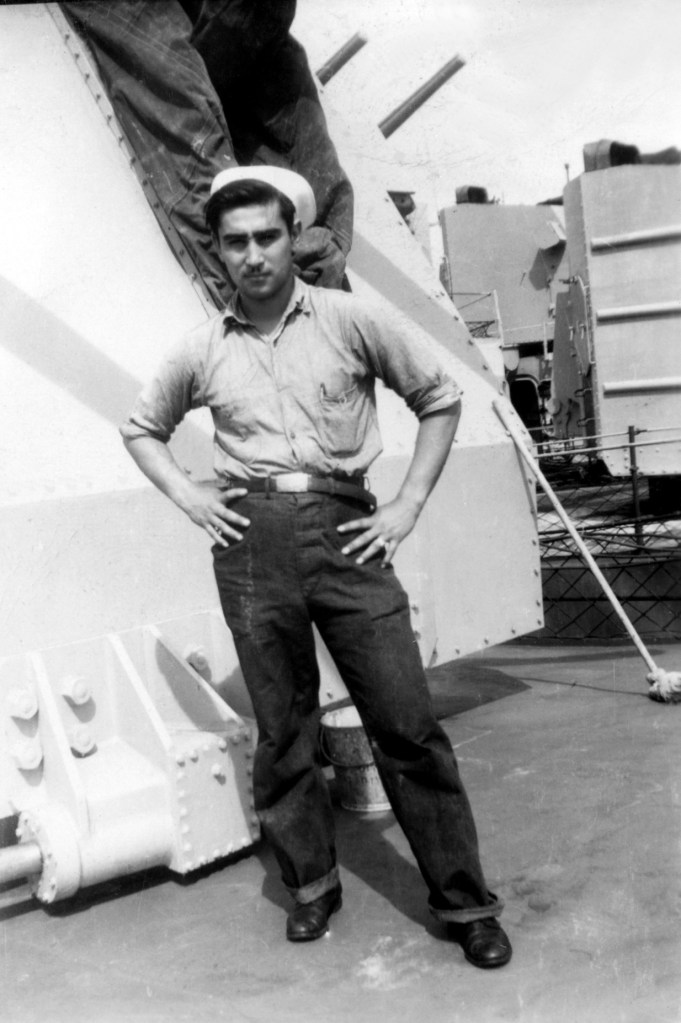
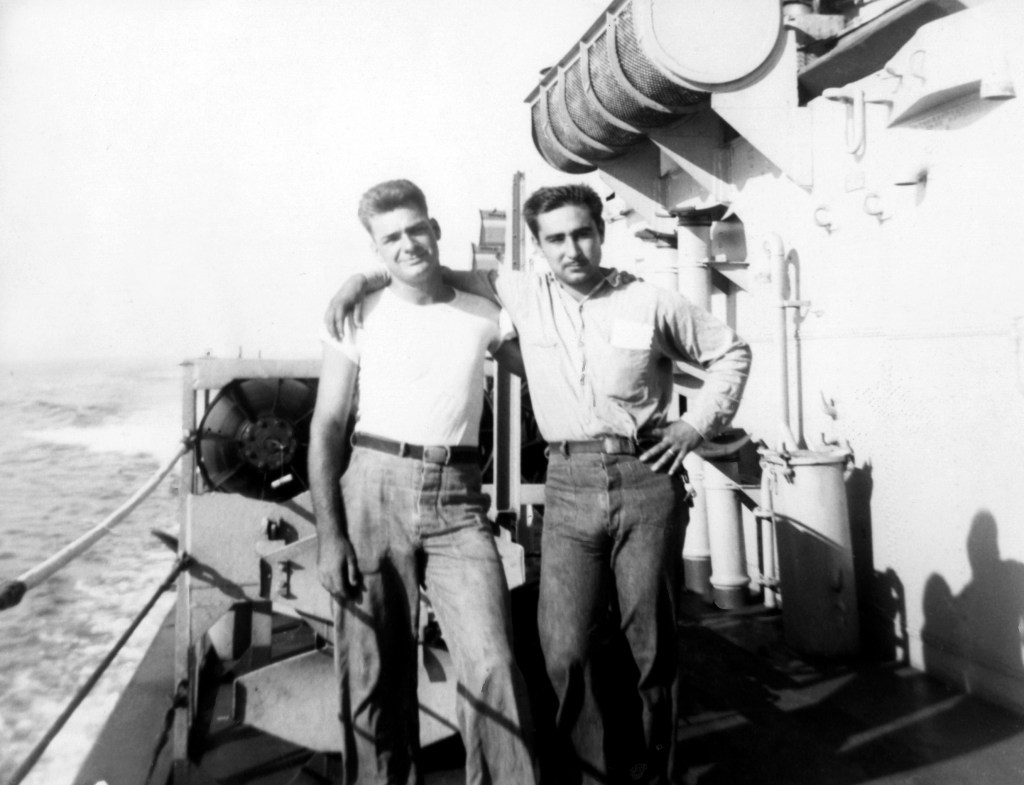
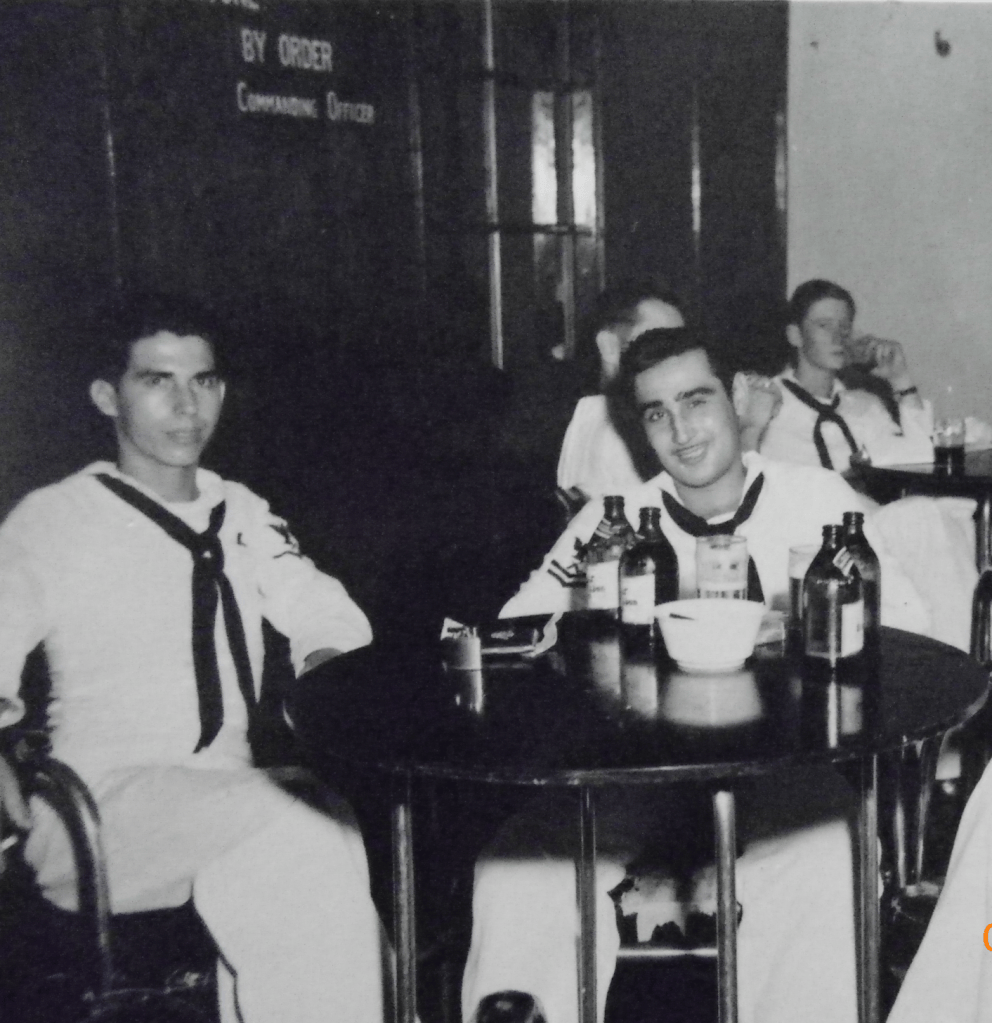
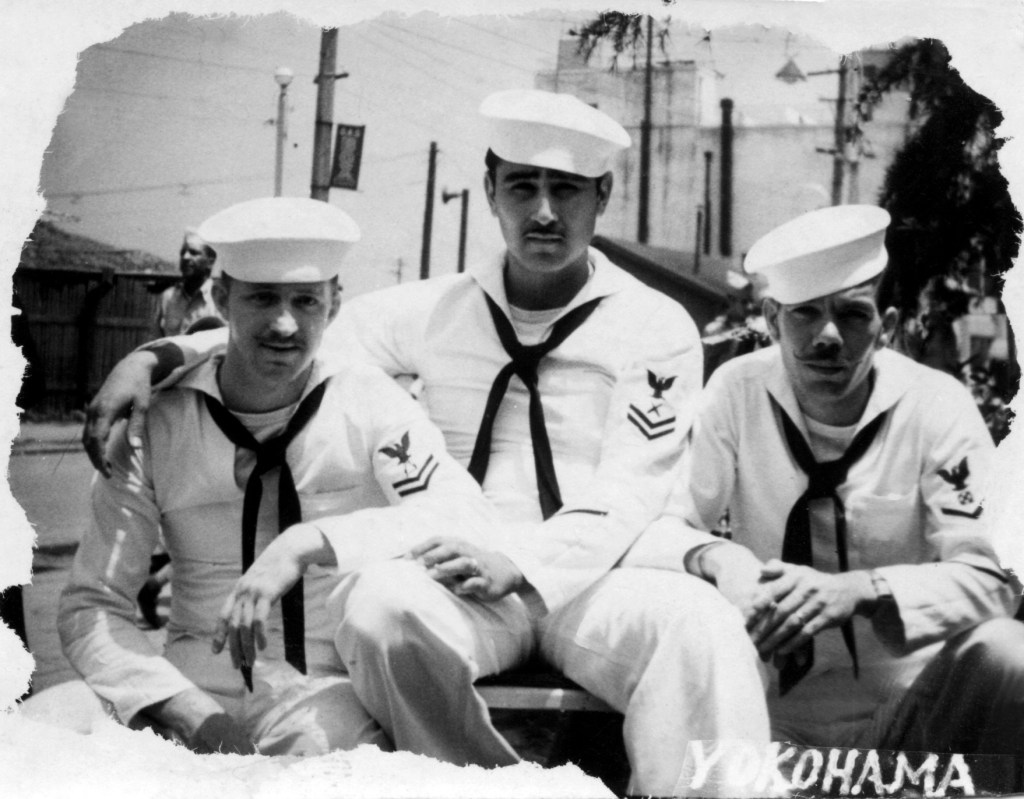
Around 1958-1959 he was assigned to the Naval Amphibious Base Coronado in the San Diego area, which became a major hub for Navy amphibious and special warfare training. Beach Jumper Unit One was a specialized U.S. Navy tactical operation to decieve and confuse enemy. There no photos.
By 1960 my father began his rise as an officer on the USS Helena. The Baltimore-class heavy cruiser USS Helena (CA-75) was stationed out of San Diego, California and served as the permanent flagship for the Commander of the U.S. First Fleet. On the the USS Helena, he earned Chief Warrant Officer (CWO) ranks of CWO1 and CWO2. As CWO on the Helena, he was the operational authority of the weapons systems on the ship.
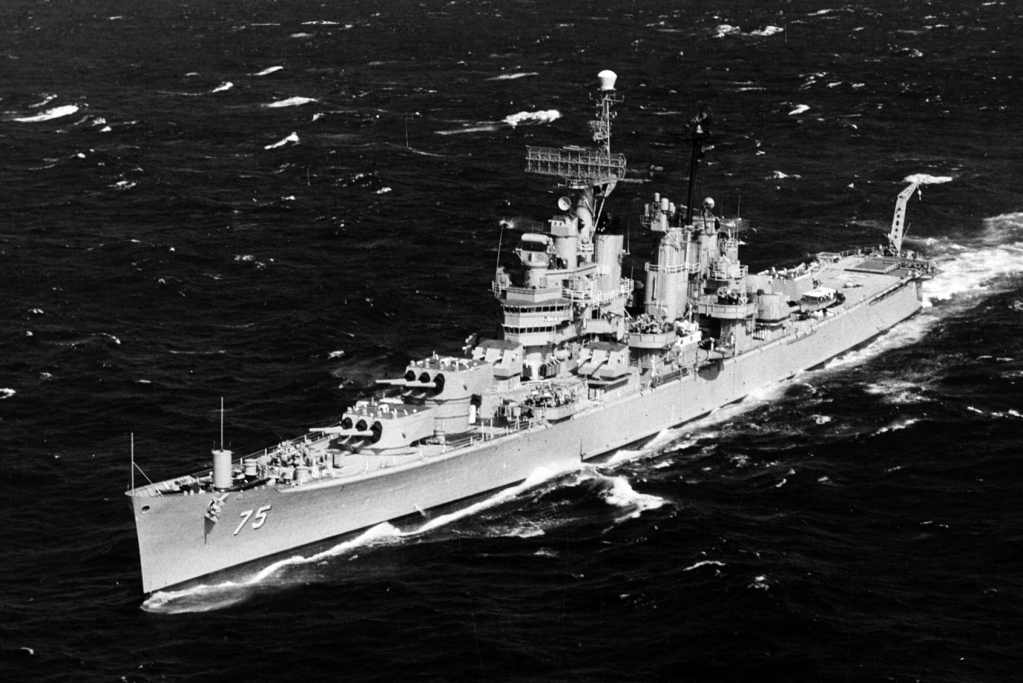
My Dad with other officers of the USS Helena. He’s probably in his early or mid 30’s. The ship led the cold war effort in the Pacific.
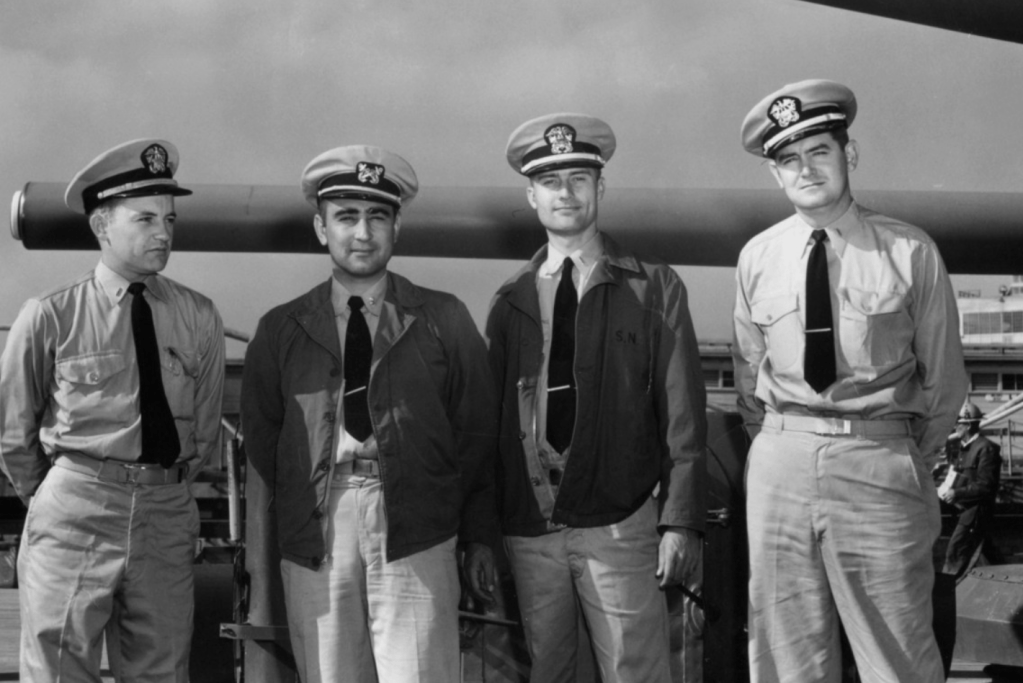
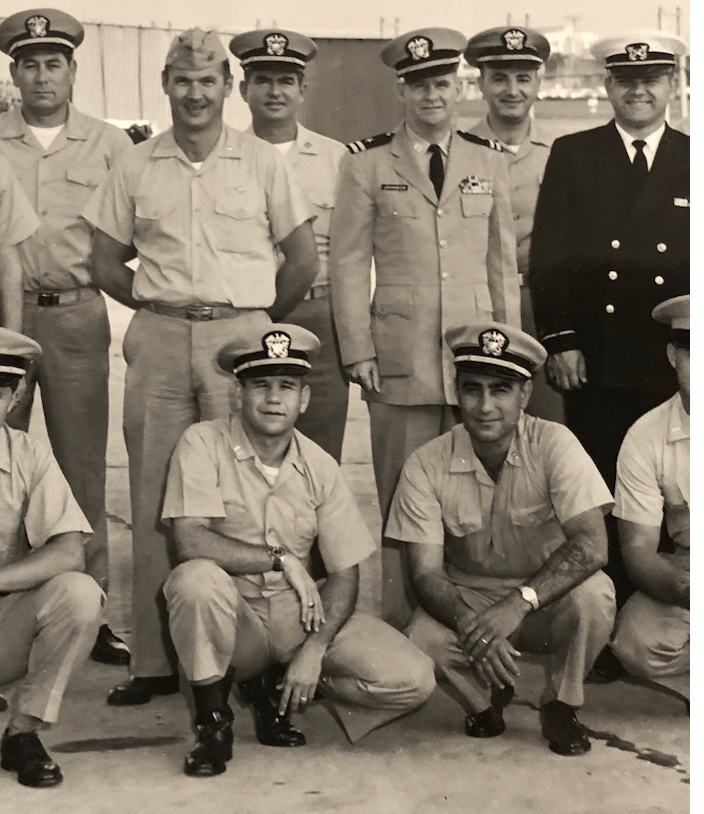
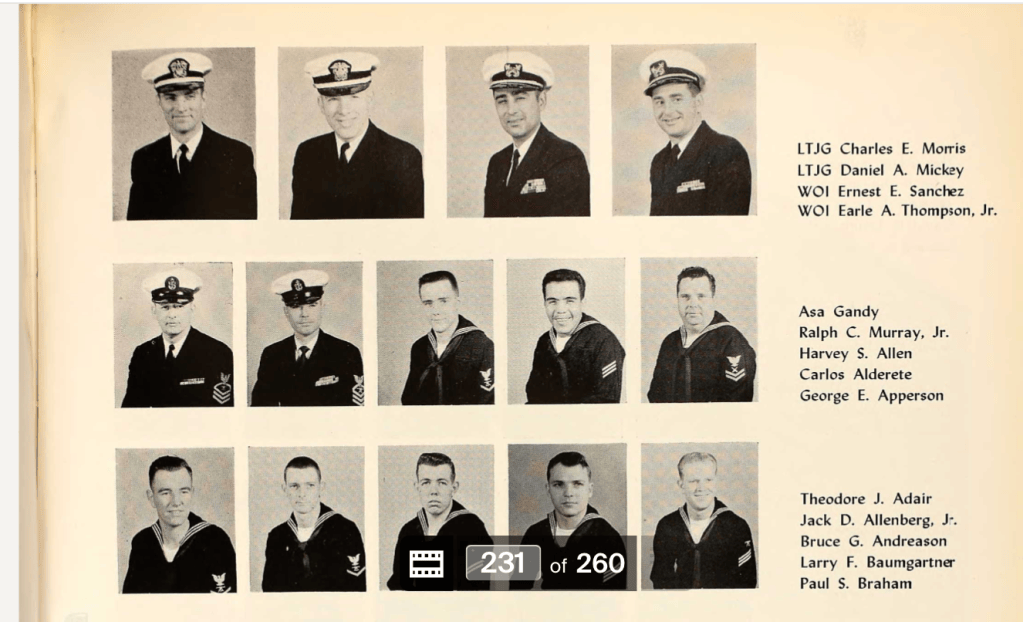
In 1962, my father was transferred to Virginia to the Anti-Air Warfare Maritime Training Center, which was historically part of the Dam Neck naval facility in Virginia Beach, Virginia. Promoted to CWO2, he most likely helped to improve the program, especially in coordinated air defense of a fleet. He also probably learned how to use new radar systems to track, identify, and intercept enemy aircraft and incoming missiles.
In 1965, my father was transferred back to San Diego. On a tour of where I worked on Sandia National Laboratories in 2005, he remembered being trained there. Known as Sandia Airbase during the 1960’s, he went through Nuclear Weapons Officer-related training through the Defense Atomic Support Agency. Sandia Base is now called Kirkland Airforce base, which is still the home of Sandia National Laboratories. In San Diego, he was assigned to the Nuclear Weapons Training Group, Pacific — North Island, San Diego (Coronado). He was assigned to the USS Bon Homme Richard as part the Navy’s deployable Special Weapons Units. He oversaw procurement, operation and maintenance of the ships tactical nuclear weapons. During this time he was promoted rapidly to CWO3 and CWO4 . At the time, CWO4 was the highest rank in the Navy for an officer without a college degree.
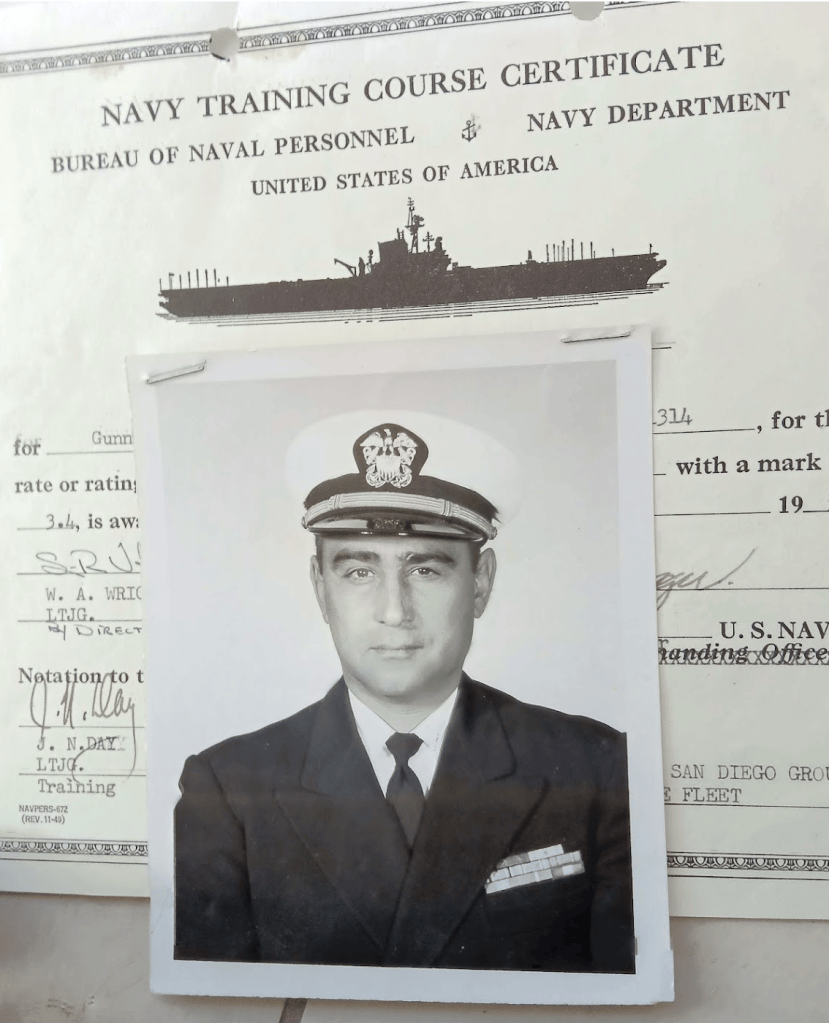
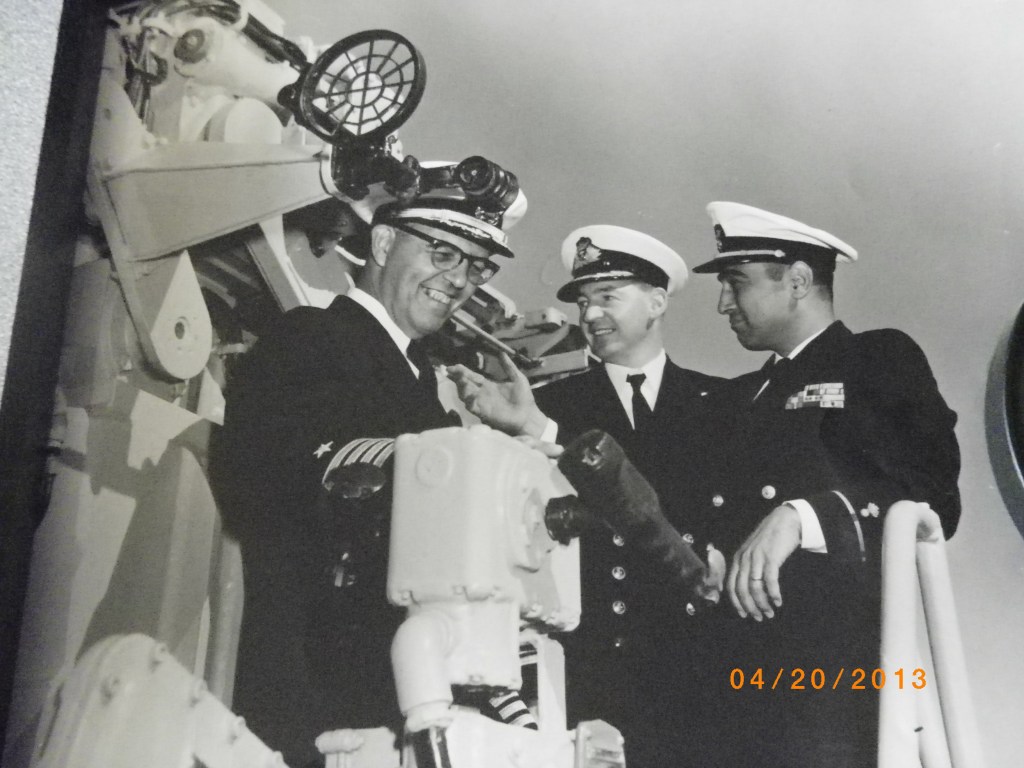
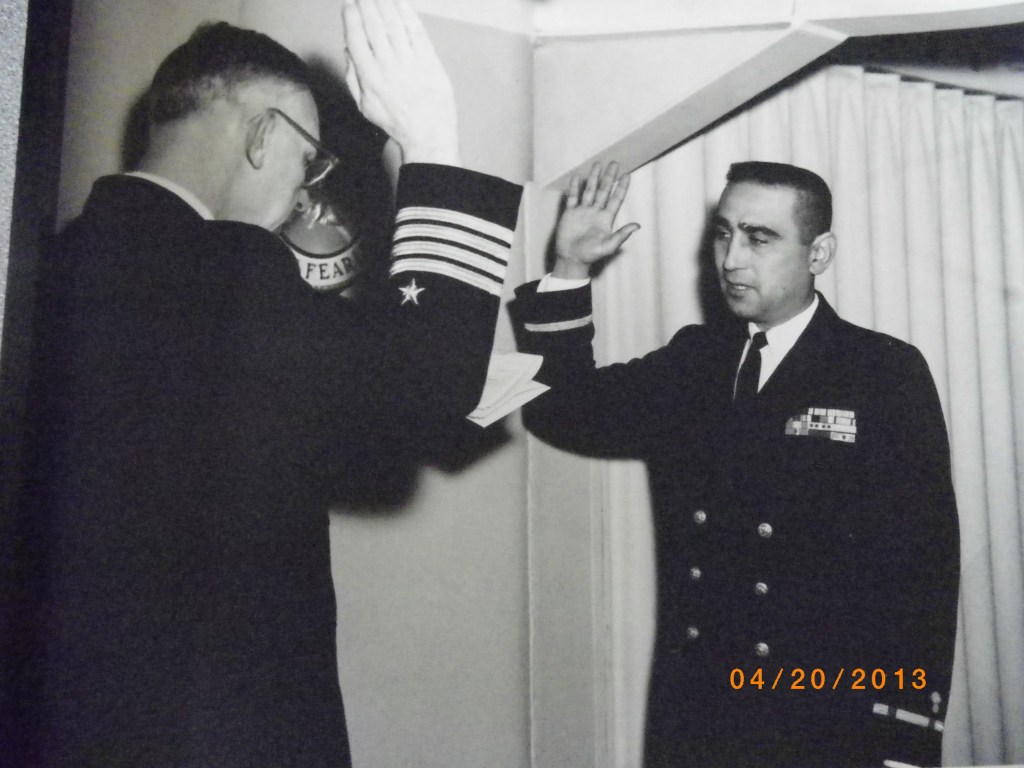
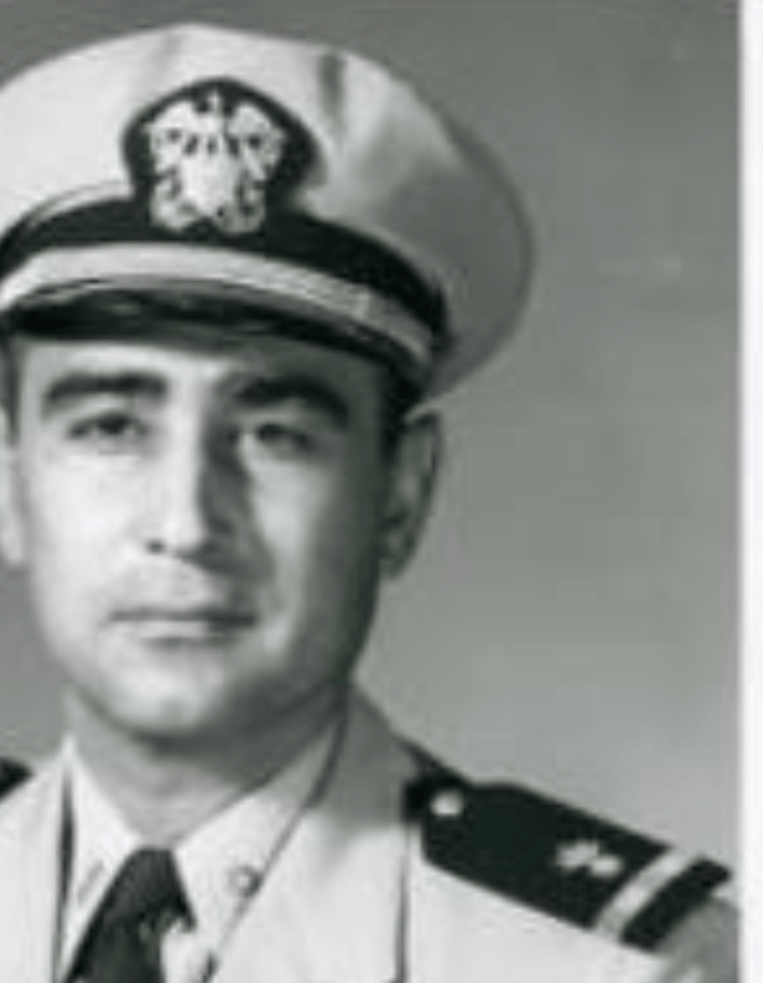
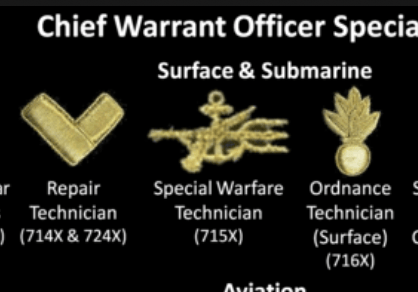
Above Left. Click to Enlarge. This is the only photo I could find that shows the Shoulder Rank. The symbol above the bar indicates Ordinance (Right Photo). The CWO 4 rank in a color photo would be a silver bar with three blue streaks. The three blue streaks in the black and white photo appear as grey streaks.
As a 12 year old, I sailed on the Bon Homme Richard in 1969-1970 on a “dependents cruise” (Below Left). He should me where he swapped bunks with another officer at different times of the day. Only recently did I find that he often had the same responsibility on other nuclear capable ships. His duties took him away from home sometimes nine months each year. Below Right. The Bon Homme Richard cruising past Point Loma, entering San Diego Bay.
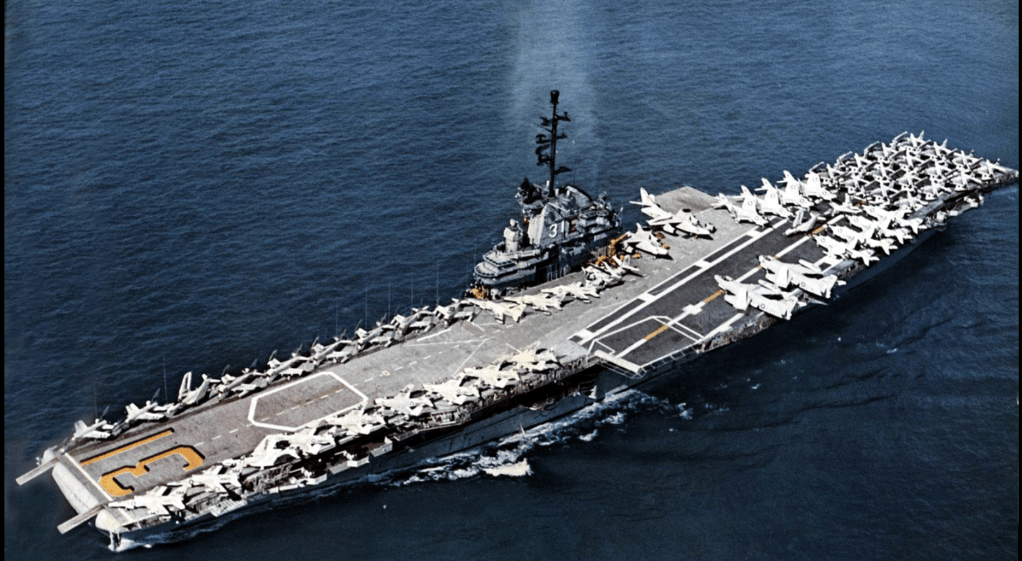
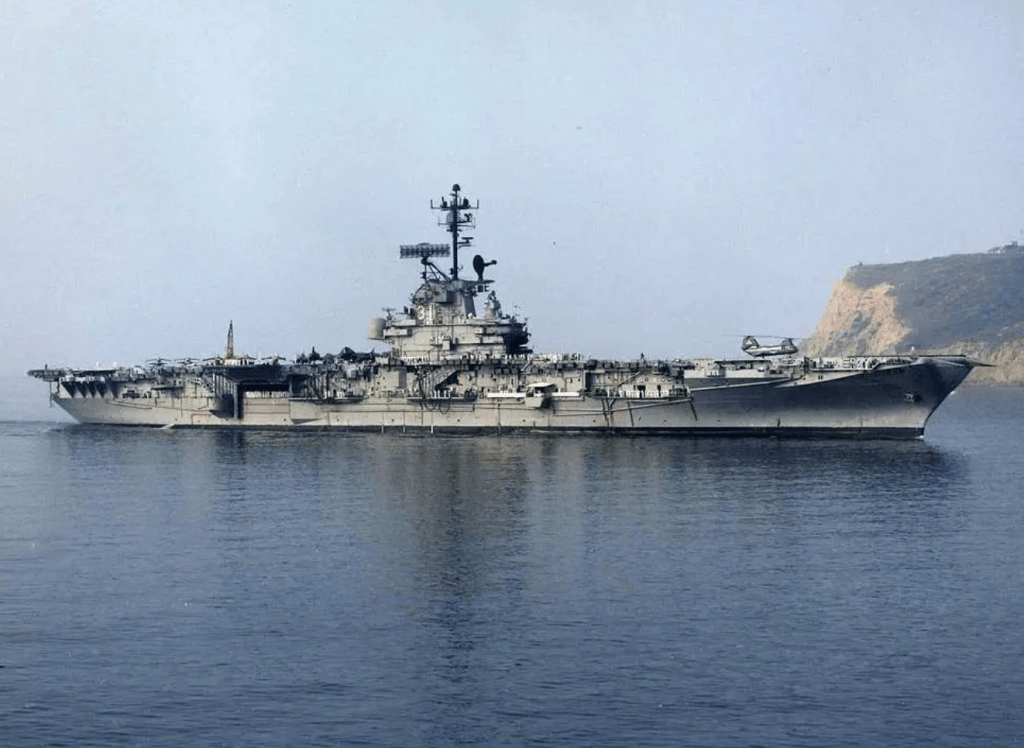
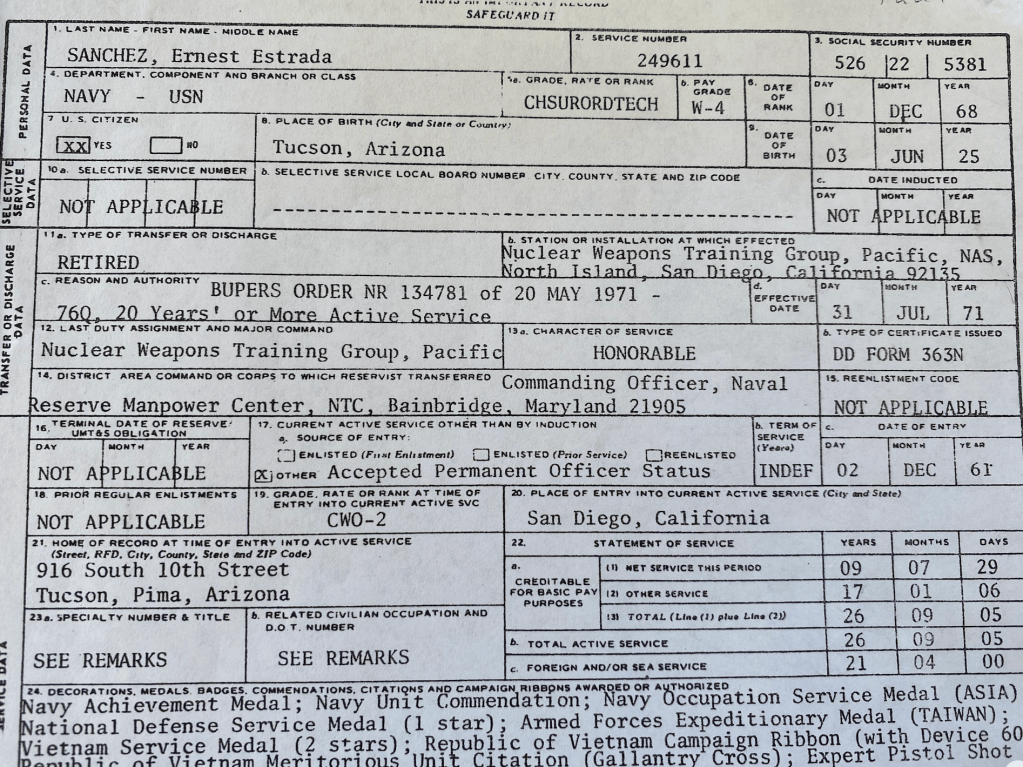
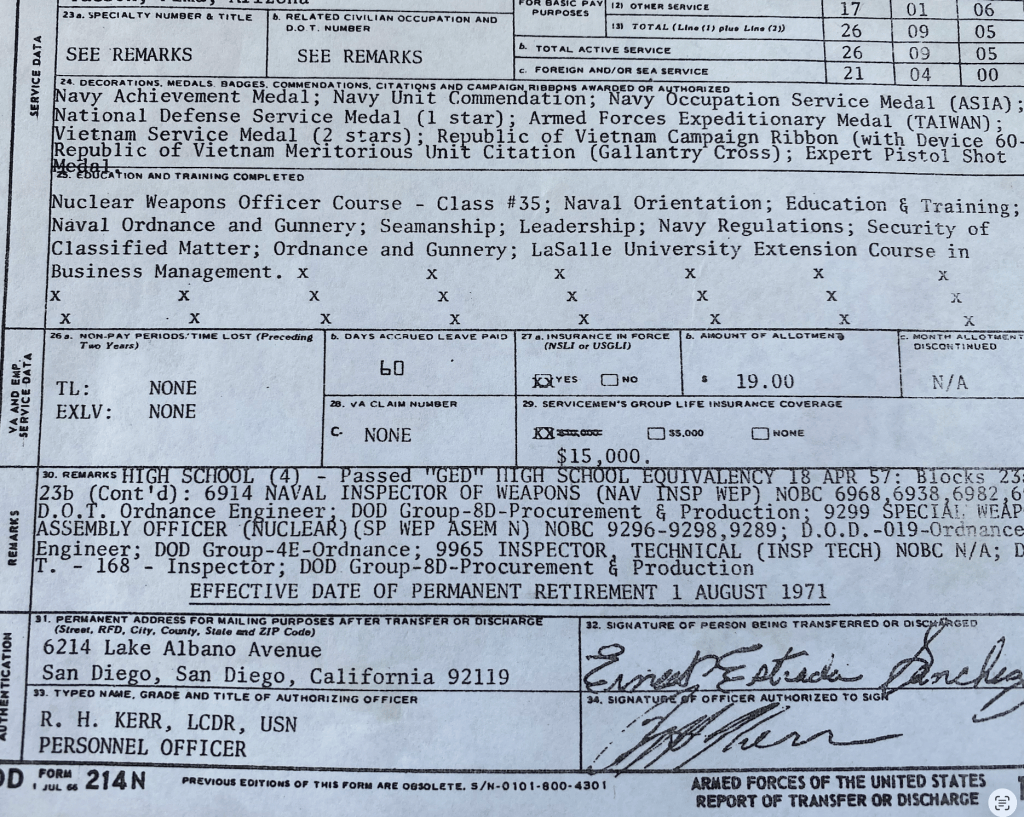
Below. This my Dad’s DD-214 form. They’re used to documental reassigments, transfers and retirements. The DD-214 does not do justice for documenting all of his training, combat and other experiences. As I stated, the USS Tucson his ship was used to occupy Japan after the war. I also shared that he was military police None of it captured. I bet the nuclear testing was classified. The official form does list decorations, medals etc. I knew he was an excellent pistol marksman. And the man I knew never owned a gun.
An important lesson I learned from my Dad was that after 25 years of achievement in the Navy, there was much work to do to enter civilian life. More work, despite his experience and responsibilities that sometimes included ship command. I remember he talked about two choices: work as a janitor or go to college. He went to junior college and at 12, I saw him study on school nights as I did my homework. I remember seeing his associate of arts degree in business and I remember him getting hired as a procurment officer for the City of El Cajon.
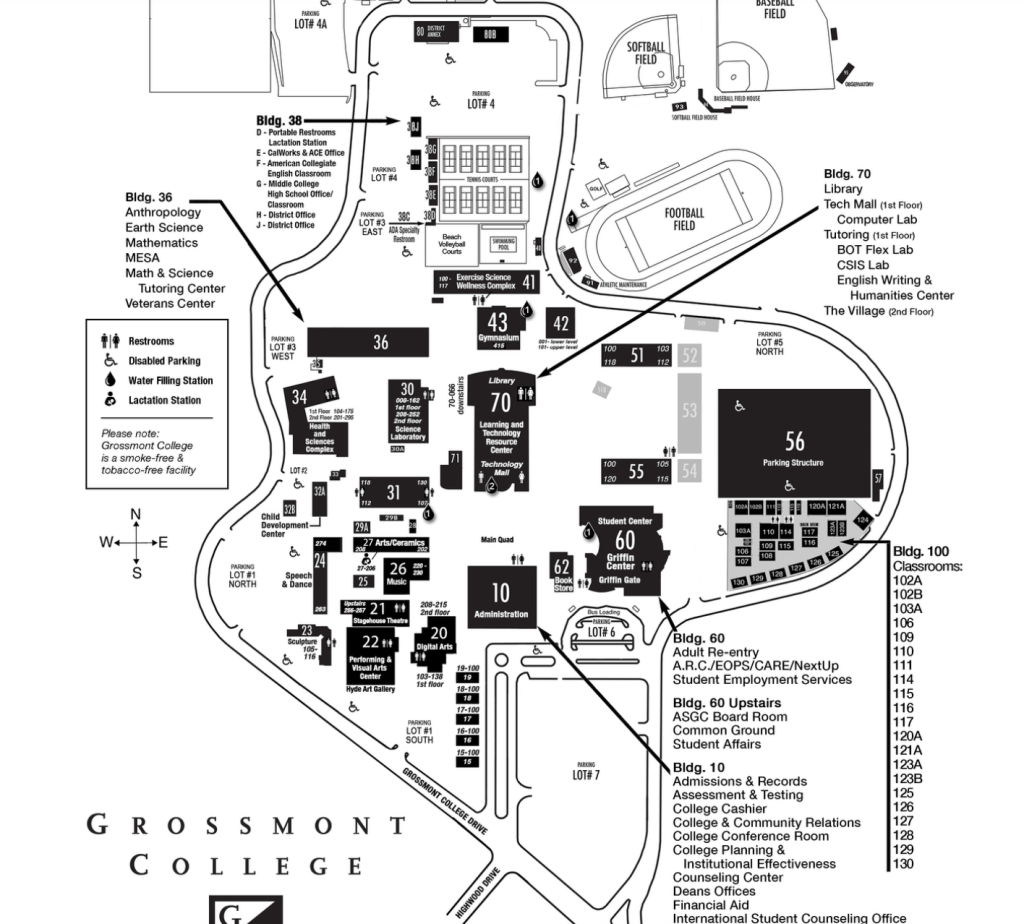
Grossmont College was part of the California Community College system built in 1961. The diagram above is from today. My Dad had matured light years from a high school drop out. Being promoted to the highest level officer without a college degree, and his continued schooling in the Navy, made his decisions for advancment easy. By 1980 my Dad rose within the City of El Cajon to Department Manager of Procurement. He wanted to be in charge of everything he did. The Knights of Columbus. The Alhambras. He was in charge of delivering food and clothes to poor families north and south of the border. I have no photos of his post-navy work. But I know he did a good job and was well respected.

